Deep Learning Docking Scores with Gnina Now in Boltzmann Maps

We’ve just added Gnina-based scoring (pronounced NEE-na) [Publication] to Boltzmann Maps — giving you another way to evaluate docking poses, side-by-side with tools like Vina, DiffDock, BMaps, and OpenMM.

Gnina extends the Vina/Smina framework with deep-learning models trained on experimental protein–ligand complexes. Instead of relying only on force-field heuristics, it predicts binding affinity from the 3D structure of a complex — using a CNN trained to recognize patterns seen in real-world binders.

Why Add Gnina?

It helps you rank, cross-check, and triage poses with an extra layer of insight.

  • Rescoring: Use Gnina to prioritize realistic poses from any method — Vina, DiffDock, or your own.
  • Pose selection: If both Gnina and your docking method favor the same pose, you have a stronger case to move it forward.
  • Hit enrichment: Combine Gnina with OpenMM minimization to pull the most plausible binders to the top of your list.

Gnina doesn’t replace traditional scores — it complements them. And in Boltzmann Maps, you can see them all in one place.

Use Cases Inside BMaps

With Gnina energies now built into Boltzmann Maps, you can:

  • View Gnina scores alongside docking scores, minimization energy, fragment maps, and water networks.
  • Run scoring on any pose set — from DiffDock, Vina, or elsewhere.
  • Filter, rank, and prioritize analogs or fragments with multiple scoring channels.

Example: Using Gnina Metrics to Gain Confidence and Find New Fragment Growing Opportunities

Here we are looking at different poses of the ligand 3TE bound to the sirtuin-2 protein 4RMG. Six poses were found using DiffDock and minimized within the protein environment using the OpenMM minimizer supported in BMaps and scored according to the BMaps interaction score calculator. These are labeled 3TE_[1-6], whereas the crystal bound ligand is 3TE.1:X

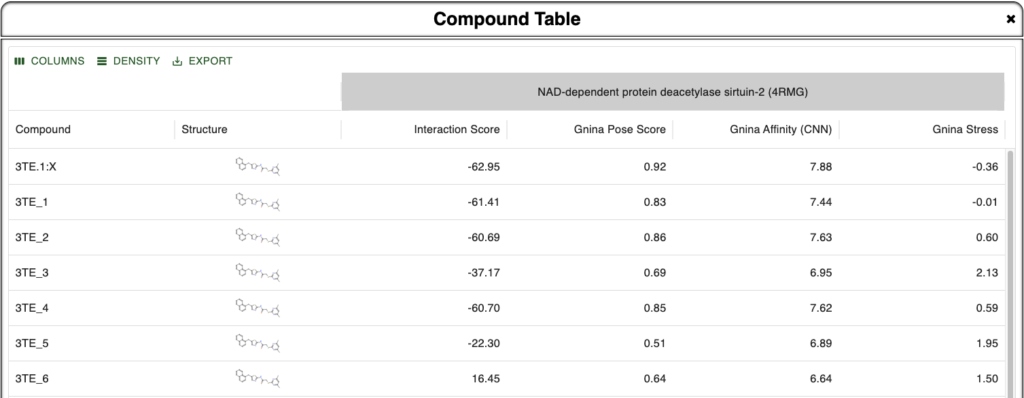
As our goal is to determine if there are any poses we may prefer to analyze over or alongside the crystal ligand pose, we turn to the Compound Table where we can compare calculated values for each compound. Rapid Gnina energy calculations are run automatically in the background and are ready by the time we open the Compound Table.

In the Compound Table we compare the Interaction Score vs three Gnina calculated values:

  • Gnina Pose Score – Gnina’s predicted probability that the pose is within 2Å of the correct binding pose [Best Value: 1.0]
  • Gnina Affinity – Gnina’s prediction of binding affinity in pK units (6 = 1 µM, 9 = 1 nM) [Higher is better]
  • Gnina Stress – Intramolecular energy calculated by Gnina [More negative is better]
Figure 1. Compound Table in Boltzmann Maps showing metrics for comparison against the crystal ligand and 6 different DiffDock derived and BMaps minimized poses.

Figure 1. Compound Table in Boltzmann Maps showing metrics for comparison against the crystal ligand and 6 different DiffDock derived and BMaps minimized poses.

From this we are instantly convinced that our crystal pose is the best pose we have been able to find as all four metrics align to show this. In addition, we see that 3TE_1 is pretty close in metrics across the board as well, so if its pose is unique, it may provide additional binding site or binding mode opportunities. Note that because we used DiffDock to perform docking and as DiffDock is a global protein docker, the docked poses may be in different sites, not just the same site as the crystal pose.

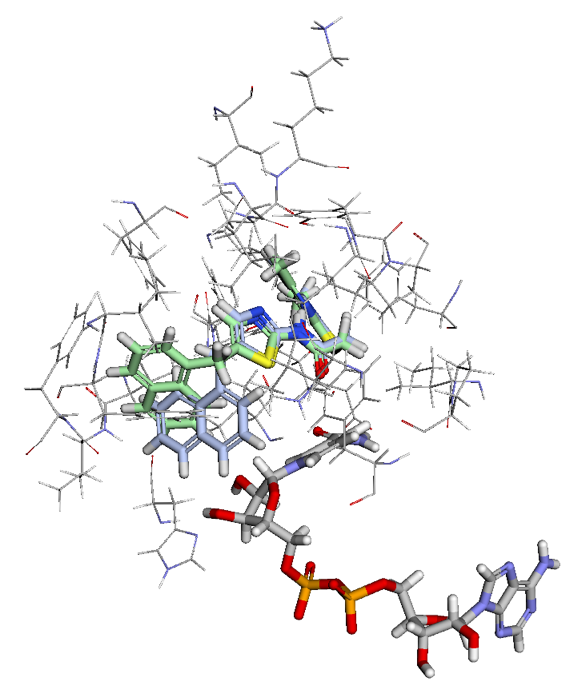
Figure 2. Ligand View of 4RMG PDB in BMaps with NAD (grey), crystal ligand 3TE.1:X in green and docked and minimized pose 3TE_1 in light blue. 3TE_1 naphthalene is rotated towards NAD and is exposed to additional pocket space as compared to the crystal ligand naphthalene.

Figure 2. Ligand View of 4RMG PDB in BMaps with NAD (grey), crystal ligand 3TE.1:X in green and docked and minimized pose 3TE_1 in light blue. 3TE_1 naphthalene is rotated towards NAD and is exposed to additional pocket space as compared to the crystal ligand naphthalene.

Looking at the two ligand poses, 3TE.1:X our crystal pose in green, and 3TE_1 our docked pose in light blue, we see that the difference between their poses is almost entirely the rotation of the dihedral between the 1,3-thiazole and the naphthalene. While the crystal pose has more of a chance to interact with the aromatic ring of the phenylalanine in SIRT-2 through a t-pose pi-pi interaction with the naphthalene, our pi-pi tool indicates that interaction is not currently occurring. Meanwhile, the 3TE_1 naphthalene pose comes much closer to forming a good hydrogen bonding angle with the hydroxyls of the interacting NAD and also gives us better access to open areas in the pocket for potential fragment growing. Indeed a fragment grow in the now accessible pocket reveals 26 fragments with binding scores that may improve the overall ligand affinity.

Comparing this newly grown fragment in the Compound Table against our crystal ligand, we see we have improved across Interaction Score and Gnina Affinity, while Gnina Pose Score and Gnina Stress indicates to us that this structure is significantly more stressed than the crystal ligand which may affect its binding stability in the pocket. We also notice that this structure is stabilized by two new pi-pi interactions with the protein which may help to overcome the penalty from the stress and also indicate a partial reason for the improved Interaction Score and Gnina Affinity.

Figure 3. Easy comparison across Gnina and Bmaps metrics in the BMaps Compound Table for crystal ligand 3TE.1:X and fragment grown compound from 3TE_1, here called 3TE_7. Table shows improved Interaction Score and Gnina Affinity and less good Gnina Pose Score and Gnina Stress.

Figure 3. Easy comparison across Gnina and Bmaps metrics in the BMaps Compound Table for crystal ligand 3TE.1:X and fragment grown compound from 3TE_1, here called 3TE_7. Table shows improved Interaction Score and Gnina Affinity and less good Gnina Pose Score and Gnina Stress.

By having the additional Gnina scoring metrics we were therefore able to gain confidence in the results of triaging alternative poses from our crystal ligand, leading to the discovery of a fragment growing opportunity to improve ligand binding. We also find the Gnina scores helpful in evaluating the results of our fragment growing opportunities to guide us towards further improvements throughout the design process as well as warn us of potential energetic liabilities that fragment grown structures may have.

Built for Comparison

Gnina fits naturally into BMaps, and as we saw with our example, using multiple methods and comparing them directly in the Compound Table can build more trust in your results than any single score could.

Here is a typical workflow:

  1. Dock (Vina, DiffDock, etc.)
  2. Minimize the ligand
  3. Score with Gnina – Done automatically
  4. Quickly overview results in the Energies tab
  5. Filter and sort using the Compound Table for deeper analysis

This makes it easier to spot strong candidates — and weaker ones — before investing in synthesis or simulations.

Move faster and design smarter with Gnina scoring available now in Boltzmann Maps.

Sneak Preview: Gnina Docking will be available in a couple of weeks!

Thank you to the authors of Gnina. You can find their publication and Github repo here:

McNutt, A.T., Francoeur, P., Aggarwal, R. et al. GNINA 1.0: molecular docking with deep learning. J Cheminform 13, 43 (2021). https://doi.org/10.1186/s13321-021-00522-2

Gnina Github Repo

Introducing real-time quantification of quantum mechanically accurate π-π interactions for drug design in BMaps

Today we introduce real-time quantification of π-π interactions in BMaps using quantum mechanically accurate methods. π-π interactions play a crucial part in the stabilizing and selectivity of protein-ligand interactions for drug design. The aromatic amino acids (Phe, Tyr, and Trp) are common interacting species in active sites, and as any examination of recently approved drugs will tell you, aromatic rings are key components of effective drugs for both interactive and structural reasons.

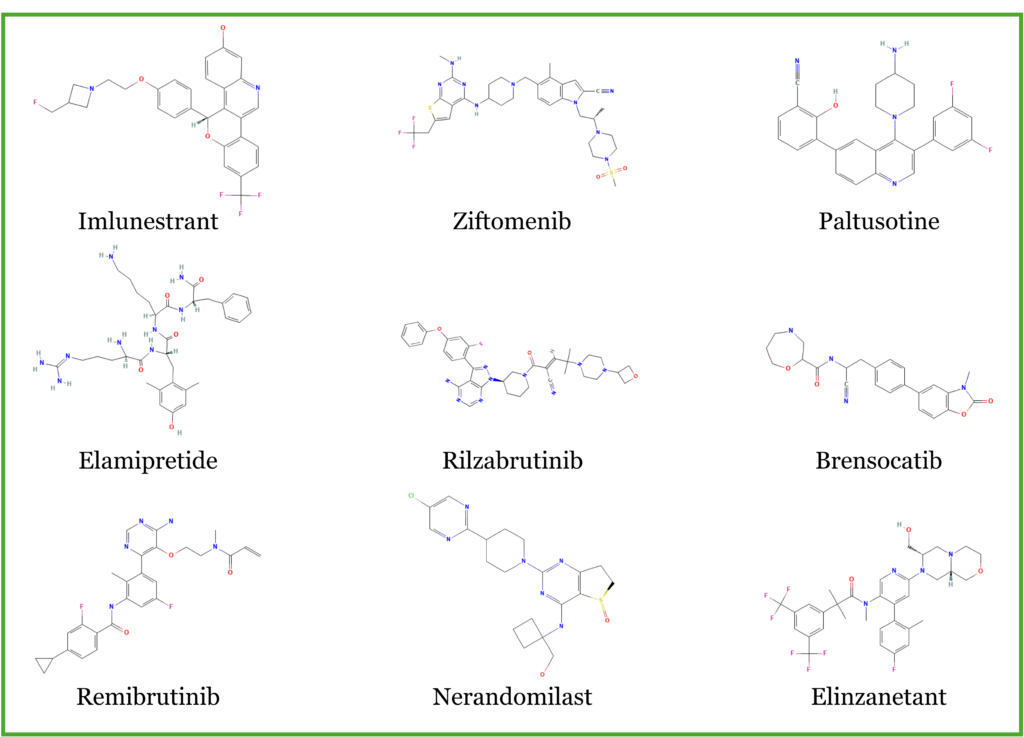
Nine drugs approved by the FDA in 2025 that have potential for pi-pi interactions.

Figure 1. Subset of 2025 FDA approved drugs with aromatic rings

For example, non-nucleoside reverse transcriptase inhibitors are known to interact selectively with HIV-1 reverse transcriptase, but not HIV-2 reverse transcriptase. As studies have shown, the HIV-1 Tyr181/Tyr188 create an aromatic cage while HIV-2 lacks this same environment. Mutation studies in HIV-1 have shown that the loss of this aromatic cage knocks out this selective binding [1, 2, 3]. Furthermore, cases like a study of Imatinib with and without inclusion of quantum mechanical (QM) energy terms in the description of protein-ligand interactions have shown 10’s of kcal/mol inaccuracy versus experimental binding energetics. When the QM energy terms are included, this error goes away. Such results make all but impossible to determine rational design trends. [4] It is for this reason that accurate quantitative understanding of the pi-pi interactions created by these aromatic rings at the quantum mechanical level is so necessary for designing new small molecules drugs.

Current Standard of Practice – Computational Scaling Prevents Quantification for Large Systems Like Proteins With QM…Or At All

Despite this importance, current methodologies of quantifying π-π interactions take days to weeks for a single calculation, often requiring simplification of the model system to perform the calculation. Therefore, until now, quantifying π-π interactions in drug design campaigns has been impractical.  Today, Conifer Point’s BMaps is changing that with the inclusion of atomistically separable quantum mechanical free energy prediction of π-π interactions. Our internally developed machine learning models are trained with density functional theory with long-range dispersion corrected functionals and complete electron wavefunction basis sets. With these quality models we can construct atomistic pictures of protein ligand interactions across the entire protein in seconds. This capability is currently not available in any other computational chemistry software or machine learning models in the literature. The key reason for this uniqueness lies in the atomistic separability of our models which will be discussed in an upcoming manuscript.

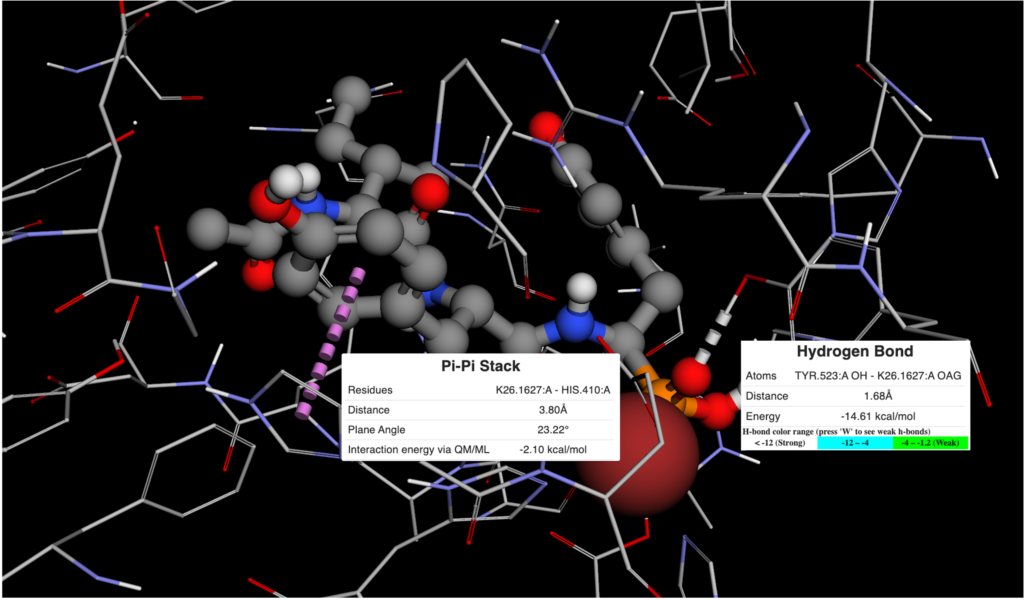
π-π interactions for drug design and hydrogen bond analysis of  4YZU

Figure 2. Visualization of π-π and Hydrogen Bonds Between 4BZR and K26 in BMaps.

See the Interactions You’ve Been Missing.

Try the π-π Interaction Tool in BMaps today!

Check out our tutorial on how to get your π-π interactions and hydrogen bonding interactions quantified in real time here or just ask Gibbs!

Let us know which interaction you want to see
automatically quantified next!

Simplifying Drug Discovery with BMaps’ AI Assistant Gibbs

Today marks the exciting release of Gibbs, an AI assistant for drug discovery within Boltzmann Maps. Our goal with BMaps has always been to democratize the complex process of pre-clinical drug discovery. Now, we take the next step towards that goal with the introduction of Gibbs.

Getting started with a new tool or technique can be a painful and time intensive process. Through searching through documentation to watching tutorials, these activities are necessary but slow down the process of science.

Enter Gibbs!

Contextualized on our database of documentation, and powered by OpenAI, Gibbs provides users with an easy and conversational way to learn how to accomplish your drug discovery and molecular visualization tasks. This reduces the normal learning curve from hours to minutes, and Gibbs’ depth and accuracy of responses have even shocked our own scientists! Here’s an example:

Our AI assistant Gibbs is ready to help with your drug discovery tasks. Some examples include: importing chemical systems, changing the visualization, and performing simple energy calculations or vendor searches. Gibbs can even help with more complicated workflows like running new fragment simulations or selectivity analysis.

This new feature is directly accessible through the Help button in the upper right of the BMaps application. You can now start your own conversation with Gibbs to assist in your workflow. Of course, our usual tutorials, documentation, and support emails are all still available. You can check the collapsed Help Information menu above the Gibbs conversation window to access those resources as well.

Built with guardrails to stay scientifically focused, Gibbs design is to help you explore and execute tasks in Bmaps. Even better, enrich your BMaps experience by letting Gibbs help you connect the dots on relevant chemistry or biology questions. Powered by OpenAI’s ChatGPT API’s, Gibbs has access to a wealth of knowledge that can accelerate your scientific and drug discovery journey.

One day, all tools will be made easy by having a knowledgable AI-based expert ready to answer your every question. For BMaps, that day is today!

As we continue to develop Gibbs’ knowledge base and give him more agency to help you streamline scientific tasks in BMaps, we are excited to hear about how Gibbs is helping you and what improvements you would like to see. As with any questions/comments/concerns the BMaps team is always excited to help at support@coniferpoint.com.

AI Protein Folding With Small Molecules Access Through Boltzmann Maps

Being able to model biomolecular structures is imperative in in silico drug design and hit-to-lead optimization. When crystal protein structures are unavailable, protein structure prediction programs have become a vital tool in scientists’ toolbox. To increase accessibility and function, programs such as AlphaFold31 have arisen to address this need. However, access to many of these tools has remained limited to academia, limiting the use of drug design in commercial spaces. These tools also are limited in predicting small molecule binding motifs. These limitations led to the production of other programs that remove that barrier for scientists, such as RosettaFold All Atom2 from David Baker’s Lab at The University of Washington, Boltz-13 developed out of the CSAIL and Jameel Clinic labs at MIT and Chai-14 from the Chai Discovery Team.

Continue reading AI Protein Folding With Small Molecules Access Through Boltzmann Maps

Analog By Catalog – Leveraging Vendor Searching in BMaps for Compound Exploration

Figure 1. Workflow of ligand optimization to generate relevant analogs that are then assessed for their commercial availability using the Mcule database.

Discovering new chemical opportunities to improve the interactions or properties of a drug hit with its biological target is essential for innovation in small molecule drug discovery. Recent enhancements integrating computational molecular modeling have accelerated this search process through virtual screening. However, even with increased computing power and more advanced simulations to better model biological and chemical systems, attaining these virtual molecules for further wet lab experiments remains a key challenge and bottleneck to the workflow.

BMaps addresses this issue by offering swift vendor database searching to check the commercial availability of compounds discovered through simulation. Currently, BMaps’ users can search Mcule which boasts a repository of over 40 million compounds. Using this integration offers access to Mcule’s similarity and substructure searching for your compound of interest which can allow for the prompt identification of relevant analogs for chemical opportunities or to ease synthetic schema. With this easy access to closely related derivative compounds, developing SAR profiles with valuable insights into the compound series’ properties and binding is also now expedited.

Synergistically, using BMaps’ fragment growing tools with the vendor searching feature, multiple derivative compounds can be explored at once and the resulting molecules can be checked for commercial availability or potential intermediates to ease synthesis. Doing these searches at each step of a fragment grow will allow you to make design decisions that utilize physics-based simulations and downstream compound accessibility simultaneously, rather than sequentially, for a more expeditious and efficient drug design process.

Whether for a large-scale virtual screening or making manual modifications on a compound of interest, using integrated tools like Boltzmann Maps with Mcule-powered vendor searching fast-tracks chemical design and streamlines the experimental testing of compounds, potentially removing the need to devise complex synthetic schemes for proposed designs. This integration aligns the efforts of computational and medicinal chemists, and embracing this approach facilitates a seamless transition from concept to reality in the drug design process.

Attaining Scientific Accessibility for Machine Learning Models

Creating FAIR Data Standards

Eight years ago in 2016, a group of scientists collaborated on an article in Nature1 to design and promote FAIR standards around scientific data. FAIR stands for – Findability, Accessibility, Interoperability, Reusability. These principles sought to guide a movement of making scientific data more FAIR, especially given the huge expansion of journals online and the creation of more and more scientific data through expedited electronic tests.

Talk to a scientist from the days of tight page limits for not just articles, but supporting information, or even farther back to those who had to interpret hand drawn figures, and you will find that conveying data in an accurate, let alone a reusable form, was not a given.

Even with greatly improved publishing technology, scientists nevertheless found themselves squinting at graphs to try to get any sense of precision values out of a bar the authors claimed was measured to 3 significant decimals.

The goal of those science professionals in creating the FAIR standards was to push for data being provided in machine-readable and raw formats such that data could not only be conveyed accurately, but such that other scientists could use that data to more reliably reproduce the results and if necessary, check the author’s work. For some, this last point was initially a concern. Would they be accused of fraud if they made an honest mistake in performing a  calculation and someone reproducing it from the raw data uncovered this? As reality has panned out, the answer to that concern turned out to be no. The online nature of journals had made submitting corrections much simpler – meaning the actual result of such standards has led to a higher integrity in the field.

The FAIR standards have since been widely adopted, with most journals requiring data to be provided in either supporting informational documents, or through download links hosted on sites like Zenodo or Github.

Accessibility for Artificial Intelligence and Machine Learning in Science

Fast-forward to today, scientific fields have seen a massive adoption of artificial intelligence/machine learning (AI/ML) into nearly every sub-discipline. Scientists regularly hear from grant officers that they should be including the use of AI tools into their studies to get funded, and just listen to any major public company’s quarterly investment calls to hear the pressure on companies to integrate AI.

Despite some of the negatives this pressure has led to (dilution from other relevant science, firing employees to pivot towards AI, etc.) this push has also led to some great successes in the ML for science space. These include examples like Alphafold2 enabling new studies that previously had to wait years for synthesis and crystal structures, to new docking algorithms like DiffDock3 that permit global docking in much faster execution times, to ProteinMPNN4 which performs 3D template based mutations of proteins to the same broadly folded structure. Certainly, the impact could not be clearer given the 2024 Nobel prizes in chemistry and physics. Machine learning could not perform so well on scientific problems without the accessibility and machine readability of data – a major result of the FAIR data standards.

Yet, as scientists try to adopt and validate published ML models, we now find ourselves in a similar situation as those who created the FAIR standards years ago. Common problems include: only text-based model descriptions are provided; the untrained model architecture as code is provided and/or the data is not provided; the model can only be downloaded on specific computers; installation or running instructions are not provided; the model is reliant on software libraries without specifying which versions; or the models can only be run on expensive hardware.

It is for this reason that we must now push for FAIR model standards – especially accessibility. So, what exactly does making a model accessible entail?

  1. Models must be provided in a coded and trained form.
  2. Instructions for installation and inference (including an inference example) should be provided.
  3. Installation instructions need to detail the versions and OS’s on which the methods have been tested.
  4. Where appropriate, training data should be open sourced so other models can be compared fairly based on training on the same data.
  5. When possible, models should not be designed such that they require hardware an average user – preferably any user – would not have access to.

BMaps – An Accessible Platform By Design – Integrates Validated ML Tools

At Conifer Point, we are using our fragment based drug design platform – BMaps – to further the accessibility of models we have been able to independently validate and think would be useful for the community. Through providing a hosted solution to accessing these tools with links to the documentation, these models are made accessible according to the 5 principles above,  and users gain easy access to these powerful technologies.

Already integrated is DiffDock3, an ML global docking methodology based on diffusion techniques that enables quick docking in ~ 1 minute. The authors of DiffDock exemplify the accessibility goals for models we outlined above. Another ML model coming soon to BMaps is GiFE5, a molecular size agnostic linear function for the prediction of quantum mechanical Gibbs free energies. This new functionality will permit users to predict binding free energies of fully solvated protein ligand complexes at density functional theorem level accuracy in force field times. A preprint publication has already been released, with a publication and Github repo coming after full release within BMaps.

With new AI-powered features coming soon that will make BMaps even easier to use for everyone from a first-time to a veteran user, we are thrilled to offer a highly accessible web-based platform where traditional computational chemistry and ML models are all easily accessed and utilized to design improved medicines.

Conifer Point would be thrilled to partner with scientists who wish to make their models accessible by integrating them into BMaps. You can do this by reaching out to info@coniferpoint.com to learn more!

(1) Wilkinson, M. D.; Dumontier, M.; Aalbersberg, I. J.; Appleton, G.; Axton, M.; Baak, A.; Blomberg, N.; Boiten, J.-W.; da Silva Santos, L. B.; Bourne, P. E.; others The FAIR Guiding Principles for scientific data management and stewardship. Scientific data 2016, 3, 1-9.

(2) Yang, Z.; Zeng, X.; Zhao, Y.; Chen, R. AlphaFold2 and its applications in the fields of biology and medicine. Signal Transduction and Targeted Therapy 2023, 8, 115.

(3) Corso, G.; St¨ark, H.; Jing, B.; Barzilay, R.; Jaakkola, T. DiffDock: Diffusion Steps, Twists, and Turns for Molecular Docking. 2023; https://arxiv.org/abs/2210.01776.

(4) Dauparas, J.; Anishchenko, I.; Bennett, N.; Bai, H.; Ragotte, R. J.; Milles, L. F.; Wicky, B. I.; Courbet, A.; de Haas, R. J.; Bethel, N.; others Robust deep learning–based protein sequence design using ProteinMPNN. Science 2022, 378, 49–56.

(5) Freeze, J.; Batista, V. GiFE: A Molecular-Size Agnostic and Understandable Gibbs Free Energy Function. chemarxiv 2023

These concepts were first presented in November 2023 at the Molecular Machine Learning Conference at MIT Jameel Clinic

DiffDock Now Implemented In Boltzmann Maps

DiffDock Diffusion-Based AI Model Available for Quick Protein-Ligand Docking in Boltzmann Maps

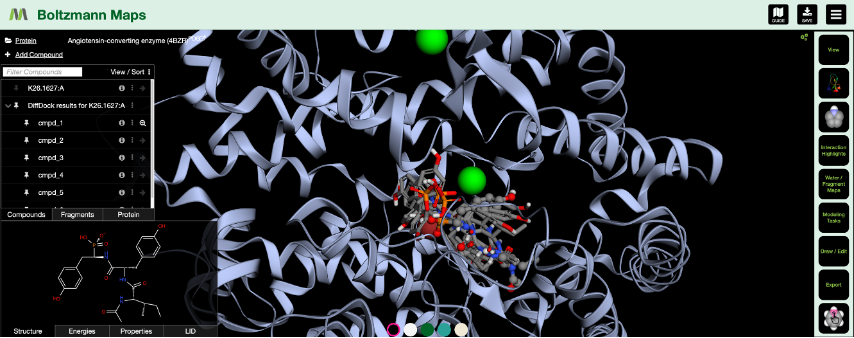
Seeking to democratize the latest tooling for computational drug discovery, the Boltzmann Maps team is proud to announce the integration of the AI model DiffDock [1]. In comparison on the PDBBind ligand docking task, DiffDock achieved a 38% top-1 success rate for binding ligands within 2A RMSD of the crystal docking site. This outperformed traditional Glide docking at 23% and other leading deep learning methods at 20% [1].Furthermore, docking runs take less than a minute for most protein-ligand combinations, transforming the possibilities for traditional computational workflows.

Visualization of DiffDock results in BMaps

Features

Now available in BMaps as an additional option alongside our previously implemented AutoDock Vina capabilities, DiffDock in Boltzmann Maps now supports:

  • Fast rigid, full-protein docking of ligands
  • Visualization of up to the 10 best poses for each docked compound
  • Energy minimization and scoring of docked poses with calculated physiochemical properties.

Use DiffDock Today!

Freely play around with DiffDock today:

  1. Log into Boltzmann Maps
  2. Bring in a protein and a compound
  3. Use options in the compound menu to dock.

Then, you can follow up your docking runs of multiple compounds by minimizing the docked geometries and calculating the energy score for each pose to discover which compound binds best to your protein of interest! Additionally, you can compare results from AutoDock Vina and hot spot analysis side by side to gain confidence in your results through the use of lateral methods.

Next Steps

This is the first post in a series of blogs on DiffDock.
See the next blog post for a full tutorial on using this tool in BMaps.

For greater detail about the theory and implementation of DiffDock, we recommend the original publication and associated Github. Stay tuned for an upcoming blog post breaking down this theory.

[1] Corso, Gabriele, et al. “Diffdock: Diffusion steps, twists, and turns for molecular docking.” arXiv preprint arXiv:2210.01776(2022).

Need help with your computational chemistry and biology tasks? Conifer Point, maker of Boltzmann Maps, proudly offers CRO services.

Alphafold AI-generated protein structure to empower Boltzmann Maps Fragment-based Drug Design

Since its first public test in 2018, Alphafold has made great strides in providing the scientific community with highly accurate AI-generated protein structure predictions. A recent database release by Alphafold contained over 200 million entries and boasts broad coverage of the UniProt protein sequence and annotation repository. Boltzmann Maps puts the power of the Alphafold database directly in the hands of users and allows for advanced analysis of protein structures.

Continue reading Alphafold AI-generated protein structure to empower Boltzmann Maps Fragment-based Drug Design

Pharmacophore screening using Pharmit in Boltzmann Maps

Boltzmann Maps is pleased to introduce an integration with Pharmit as an option for pharmacophore screening. Pharmit is a search tool for finding small molecule inhibitors that bind to a target of interest. The tool searches libraries for compounds with desired features in the right geometry. Boltzmann Maps integration allows the user to send a protein-ligand system from BMaps to Pharmit for search based on the compound’s features or other user-specified features. Pharmit’s nine built-in libraries include almost 250M compound entries, and the 1,059 publicly accessible user-contributed libraries contain another 45M entries.

Pharmit can be accessed via the Export button on the bottom right of the BMaps web app.

Continue reading Pharmacophore screening using Pharmit in Boltzmann Maps

100% PDB Availability and Automation of Protein Preparation

With the new release of Boltzmann Maps comes enhanced reliability for protein structure loading and automation of protein preparation for energy minimization, docking and fragment simulations. The entirety of the Protein Data Bank (PDB) is now available to view in Boltzmann Maps. 

As an example, log into BMaps to view PDB ID 3n7h: https://www.boltzmannmaps.com/structure/3n7h. The PDB featured this mosquito odorant binding protein in complex with DEET (DE3 ligand) as one of the “Molecules of the Month” for June 2023.

Continue reading 100% PDB Availability and Automation of Protein Preparation